
Just a hash of thoughts from an untidy, yet entertaining, brain.

  • The Pro Football Serial Movers’ Map

    There are projects you plan.

    Then there are projects that begin with listening to a podcast, thinking “Huh, that’s weird,” and somehow end with your printer begging for mercy while you tape together twelve sheets of paper on a piece of cardboard that used to protect your television.

    This is the second kind.

    I had been listening to a podcast (The Move: The Indianapolis Colts) about one of the stranger episodes in professional football history, and it reminded me just how little sense the geography of the NFL makes if you start digging backward.

    I went down a rabbit-hole on the whole subject, then fell into a gopher hole, then a vole hole. It was a very strange trip. And I came to this realization.

    Teams move. Teams almost move. Teams move away and come back. Cities lose a team and eventually get a completely different one with a suspiciously familiar name. Owners trade franchises. Leagues merge. Other leagues collapse. During World War II, teams temporarily merged with each other because there simply weren’t enough players.

    And then there are the Raiders.

    Oakland → Los Angeles → Oakland → Las Vegas.

    Gotta go. We’re here. We’re back. We gamble.

    Seattle, meanwhile, managed an equally strange story without actually moving anywhere. In 1996, the Seahawks came alarmingly close to becoming an Anaheim team before the whole thing collapsed.

    That was when I started thinking this history really needed a map.
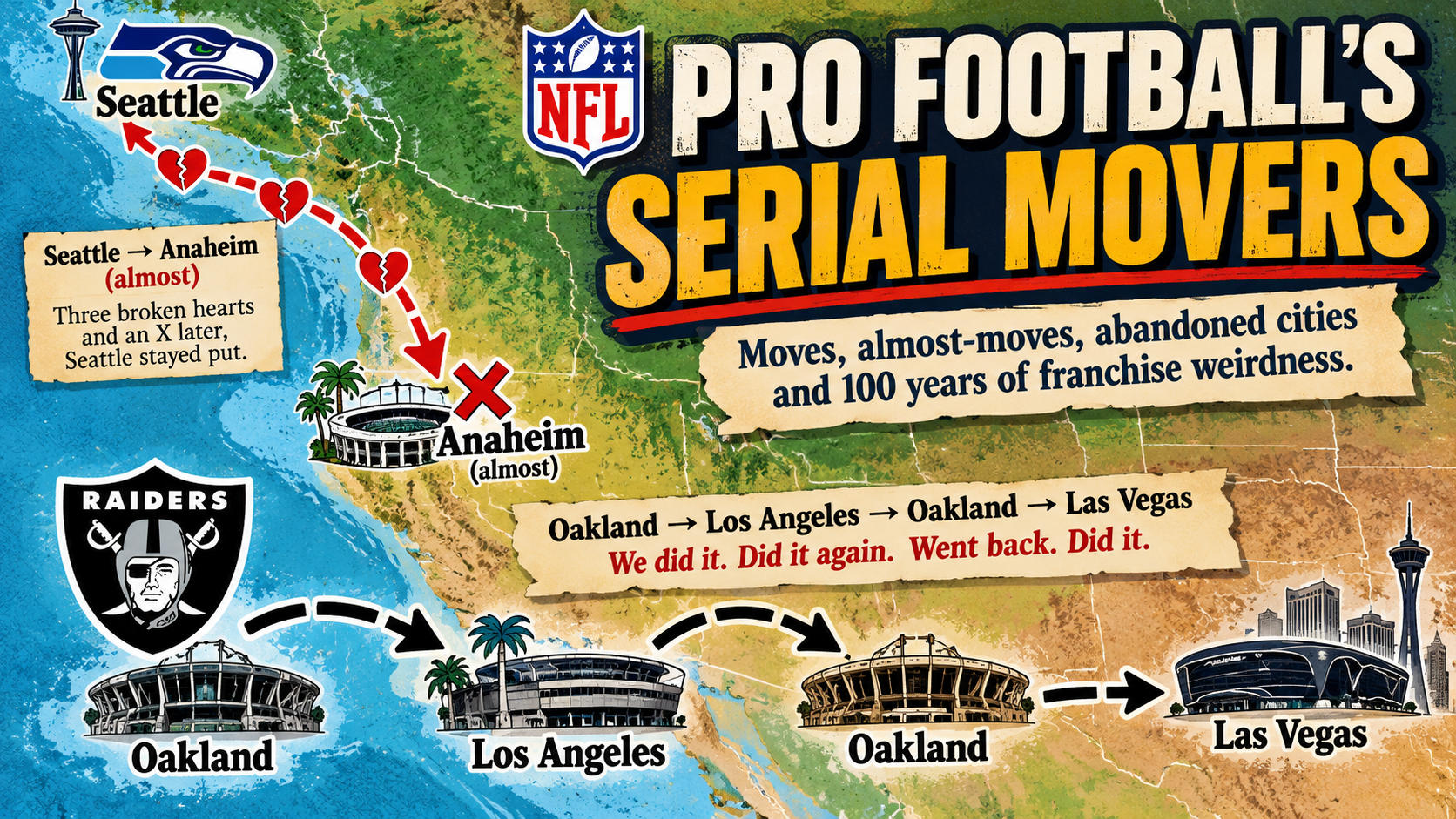
    This seemed simpler in my head

    My original idea was basically, “Put the franchise moves on a map.”

    That sounds manageable.

    It was not.

    Once I started looking at actual franchise histories, a simple relocation map stopped being enough. The Browns/Ravens story isn’t a normal relocation. The Dallas Texans of 1952 are not the Dallas Texans who became the Kansas City Chiefs. The Houston Oilers became the Tennessee Titans, while the current Houston Texans are an entirely separate franchise.

    Then I started adding serious moves that almost happened.

    Then temporary stadiums.

    Then former stadiums.

    Then the AFL.

    Then the AAFC.

    Then the USFL.

    At some point I had 34 separate historical stories that deserved numbered notes, eight NFL divisions that needed their own boundary patterns, current stadiums, historic stadiums, franchise routes, abandoned routes, near-moves, mergers, ownership swaps and one extremely specific trail of broken hearts between Seattle and Anaheim.

    This had stopped being a map.

    It was becoming evidence.

    The part where I remembered vectors exist

    The project became much easier once I stopped treating the thing like one giant picture.

    I found a very good vector map of the United States, and that changed everything.

    I had somehow forgotten an old graphics lesson I learned years ago: for something like this, you don’t really want to be moving pixels around. You want objects.

    A stadium should be an object.

    A route should be an object.

    A team logo should be an object.

    An inset should be a group of objects that can be picked up and moved as one piece.

    That distinction turned out to matter almost more than the fact that vector graphics can be scaled indefinitely.

    When the New York/New Jersey, Pennsylvania and California insets were covering too much of the East Coast, I could simply move the entire groups out over the Atlantic. When three information panels at the top looked randomly scattered, they could be resized and snapped together into one intentional row.

    Current stadiums could stay locked while historical ones were reduced.

    Nothing underneath needed to be repainted.

    Nothing had to be reconstructed from a flattened image.

    I should have done it that way from the beginning.
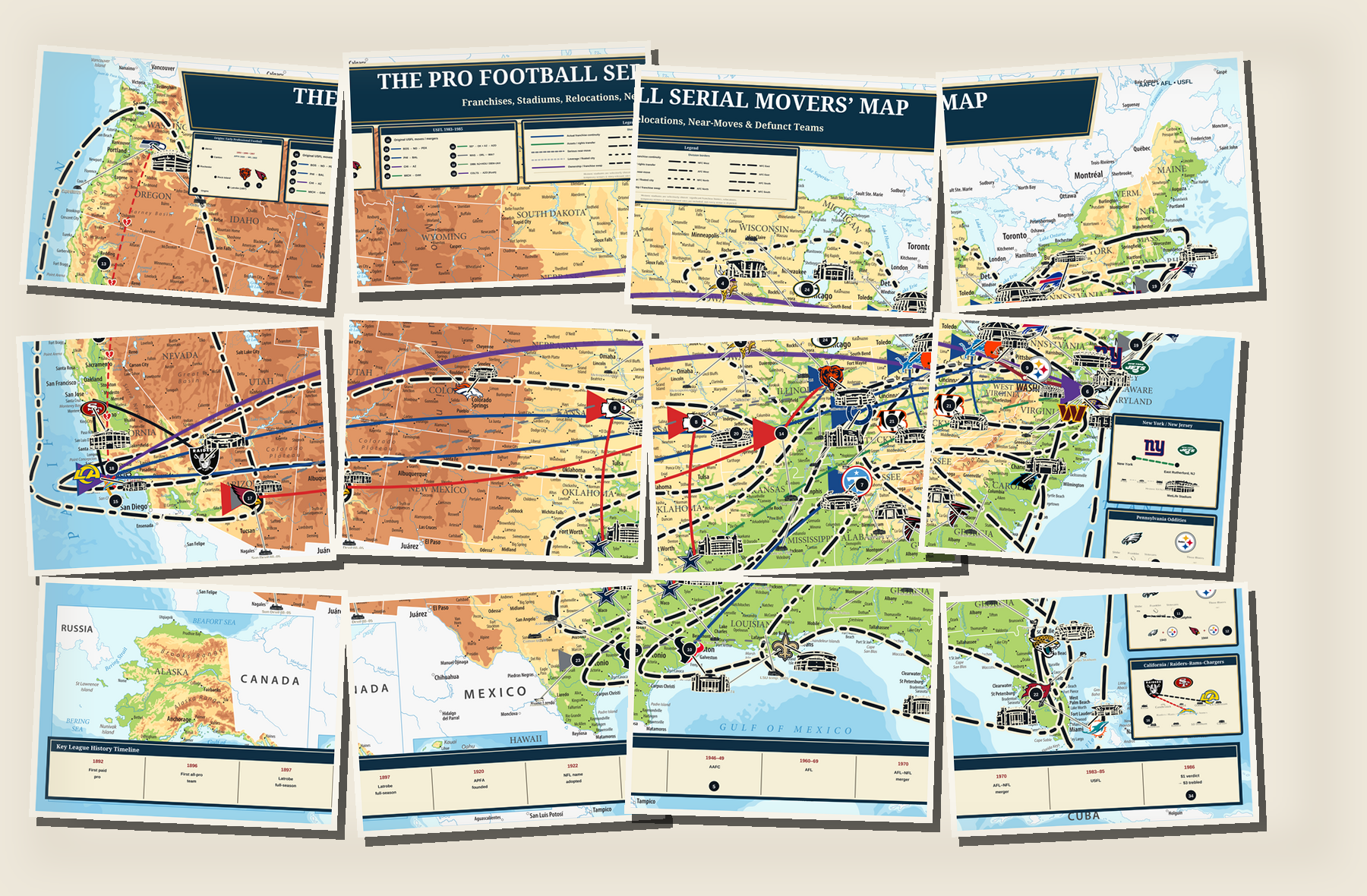
    Mad Magazine has nothing on me!

    The stadium problem

    The stadiums created another problem I hadn’t really anticipated.

    There are a lot of them.

    The current NFL has 32 teams sharing 30 stadiums. (Jets/Giants, and Rams/Chargers literally share stadiums) That part was straightforward enough. The current stadiums became the primary visual layer and stayed relatively large.

    Historical stadiums were another matter.

    If I gave every old stadium the same visual weight as a current one, the map turned into a convention of tiny buildings.

    So I ended up creating a hierarchy.

    Current stadiums stayed full size.

    Older stadiums that still exist were reduced.

    Demolished stadiums were reduced even further.

    I also stopped trying to show every historical stadium just because I had artwork for it. The legend now explicitly says that historic stadiums are selectively shown — significant franchise homes, relocation sites, temporary venues and story-relevant stadiums are included, but not every venue ever used by every team.

    That decision made the map much better.

    Complete is not always the same thing as useful.

    And then I printed the thing

    The finished map is 36 by 24 inches.

    My printer uses ordinary letter-size paper.

    You can probably see where this is going.

    The first solution was to divide the poster into twelve pages, four across and three down.

    That worked.

    Technically.

    It also introduced far more scissor work than I wanted.

    Then I remembered that my printer can print edge-to-edge.

    Or rather, it can print edge-to-edge under extremely specific circumstances that apparently must be discovered through ritual.

    Printing a PDF as a document? Margins.

    Printing an image as a photo? Borderless.

    Selecting plain paper? Borderless disabled.

    Telling the printer that the exact same sheet of plain paper was “other photo paper”?

    Suddenly borderless printing was available.

    The printer and I reached an understanding.

    I also selected Best quality, at which point the printer apparently decided every sheet deserved individual contemplation.

    By the end, it had printed twelve pages, then another 24 pages during an ill-fated experiment with duplex instructions, and then twelve more pages at Best quality.

    Printy wanted a nap.

    Assembly required

    There was one more surprise.

    Borderless printing is not precision engineering.

    Each sheet can feed slightly differently, and borderless mode overscans the image a little so it doesn’t leave white slivers around the edges. That meant two neighboring sheets could have the artwork perfectly aligned while the physical edges of the paper were a millimeter or two apart.

    So I stopped trusting the paper.

    I aligned the picture.

    The twelve pages overlap, and I ended up using matte Scotch tape across the joins. It is not archival mounting. It is not museum conservation.

    It is a giant homemade football-history poster.

    I can live with that.

    The mounting board, incidentally, is a huge shaped piece of corrugated cardboard that I had been using as a puzzle table. I had completely forgotten where it came from until I noticed the shipping markings on it.

    It came with my new television. I have a post about that; I’ll put that up soon.

    When I unpacked the TV, I apparently looked at this enormous flat piece of cardboard and thought, “That is worth saving.”

    Past me was correct.
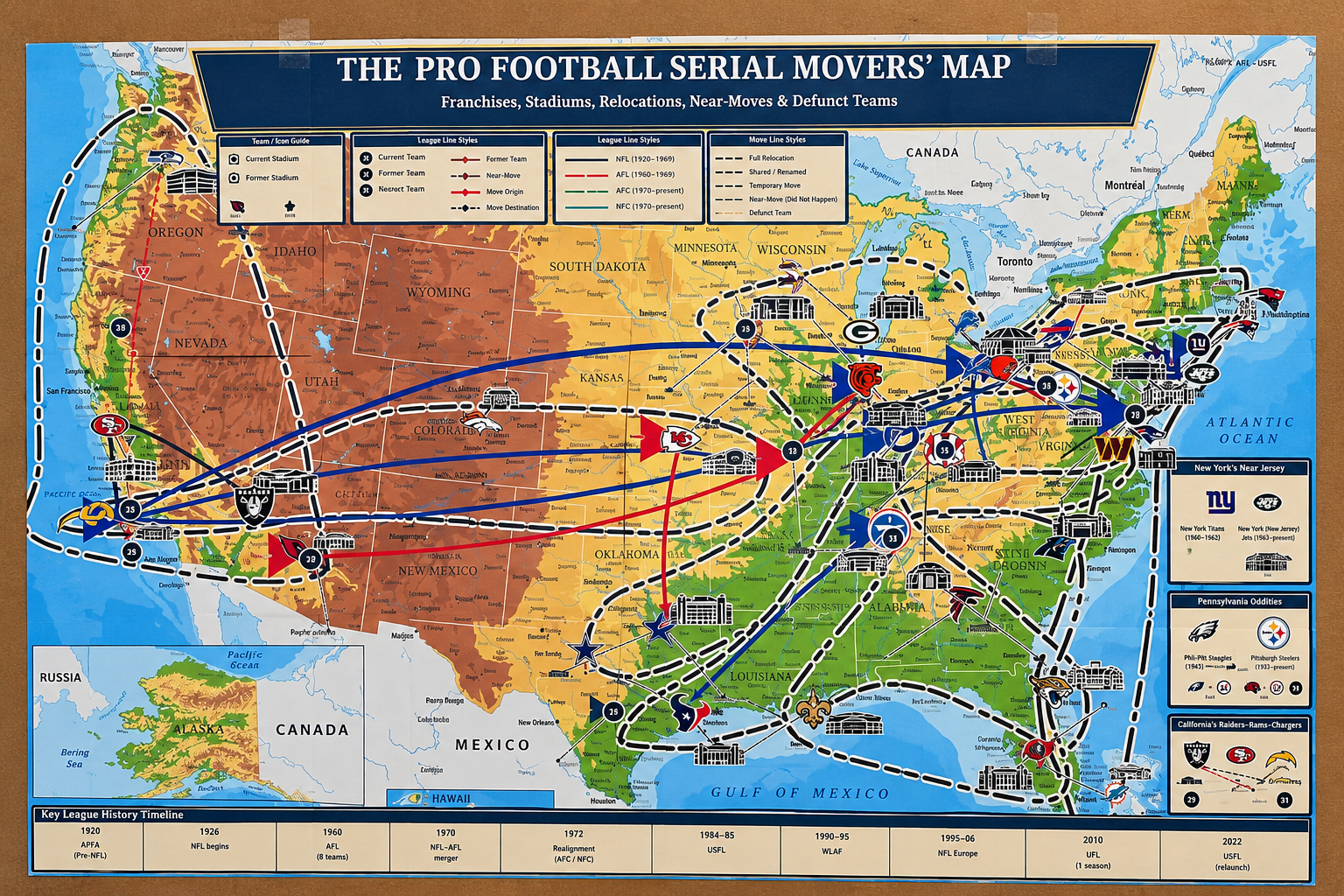
    TV cardboard, check. Scotch tape, check. Sanity, missing.

    The actual map

    And after all of that, here it is.
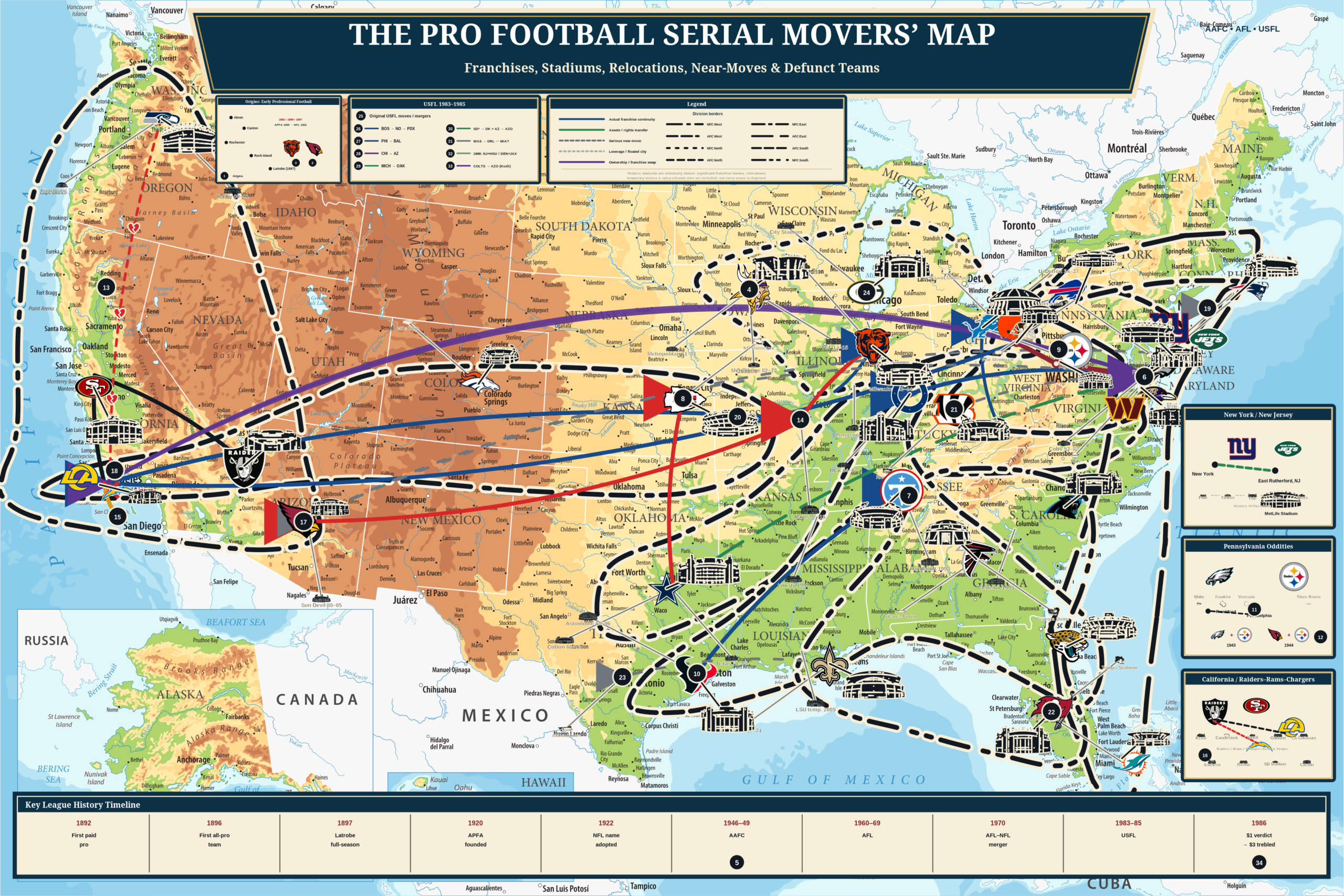
    Complicated, I’ll show you complicated!

    The numbered markers correspond to the notes below. Some are major franchise relocations. Others are near-moves, league mergers, temporary arrangements or wonderfully strange pieces of football history that didn’t fit neatly into a normal relocation arrow.

    Early pro football / league origins

    ① Where pro football starts
    William “Pudge” Heffelfinger was paid $500 to play in 1892, the Allegheny Athletic Association fielded the first entirely professional team for a short season in 1896, and Latrobe became the first club to play a full season using only professionals in 1897. The APFA—the direct ancestor of the NFL—was organized in 1920 and renamed the NFL in 1922. Pro Football Hall of Fame chronology

    ② The Cardinals are older than the NFL
    The Cardinals trace their continuous history to Chris O’Brien’s Morgan Athletic Club in Chicago in 1898. They became the Chicago Cardinals, moved to St. Louis in 1960, moved to Arizona in 1988 as the Phoenix Cardinals, and adopted “Arizona Cardinals” in 1994. The Hall of Fame calls them the oldest continuously operating team in professional football. Cardinals team history — Pro Football Hall of Fame

    ③ Only two charter-era survivors remain
    Of the clubs represented at the APFA’s 1920 organizational meeting, the two surviving franchise lines are the Decatur Staleys/Chicago Bears and the Racine/Chicago Cardinals, now the Arizona Cardinals. Founding of the NFL — Pro Football Hall of Fame

    ④ Minnesota chose the NFL over the AFL before playing a game
    A Minnesota ownership group was awarded an AFL franchise in 1959, then forfeited that AFL membership five months later and accepted the NFL’s 14th franchise instead. The Vikings began play in 1961. The AFL filled the abandoned Minneapolis slot with the new Oakland Raiders. Vikings team history — Pro Football Hall of Fame

    ⑤ The AAFC sent three teams into the NFL
    When the All-America Football Conference folded after 1949, the Cleveland Browns, San Francisco 49ers and original Baltimore Colts entered the NFL for 1950. Cleveland and San Francisco survived; that first Baltimore Colts franchise did not. AAFC history — Pro Football Hall of Fame

    Franchise continuity oddities

    ⑥ There were two completely different Baltimore Colts
    The first Colts played in the AAFC from 1947–49 and one NFL season in 1950 before folding. The Baltimore Colts established in 1953 were a new franchise and are the franchise that eventually moved to Indianapolis. NFL history 1940–1959 — Pro Football Hall of Fame

    ⑦ The strangest ancestry of the modern Colts begins in New York and Dallas
    The NFL took back the New York Yanks franchise in 1952. Dallas investors purchased Yanks assets and received a new Dallas Texans franchise, which went 1–11 and folded after a single season. In 1953, Baltimore was awarded another new franchise plus the holdings of the dead Dallas organization. That is why the map shows a tombstone at the 1952 Texans and a green assets line emerging from the grave toward the 1953 Colts. 1953 franchise history — Pro Football Hall of Fame

    ⑧ The other Dallas Texans became the Chiefs
    Lamar Hunt’s unrelated AFL Dallas Texans began play in 1960, won the 1962 AFL championship, moved to Kansas City in 1963 and became the Chiefs. Same city, same “Texans” name, entirely different franchise from the one-season NFL Texans of 1952. Chiefs ownership and franchise history

    ⑨ The Browns moved—but the Browns did not
    The 1996 settlement allowed Art Modell’s football operation to move to Baltimore and become the Ravens, while Cleveland retained the Browns’ name, logo, colors, history, records, trophies and memorabilia. The Browns were dormant for three seasons and resumed play in 1999. 1996 NFL history — Pro Football Hall of Fame

    ⑩ Houston lost the Oilers but later got a completely different Texans franchise
    The Oilers were founded in Houston in 1960, moved to Tennessee in 1997, played two seasons as the Tennessee Oilers, and became the Tennessee Titans in 1999. The Houston Texans, who began play in 2002 through expansion, are a separate franchise with no continuity from the Oilers. Titans franchise history

    Swaps, wartime weirdness, and ownership oddities

    ⑪ The 1941 Pennsylvania Polka may be the strangest franchise shuffle in NFL history
    Art Rooney sold the Pittsburgh organization to Alexis Thompson, then joined Bert Bell’s Eagles. When Thompson’s intended move to Boston failed, the groups traded territories: the Rooney-Bell Eagles organization went to Pittsburgh and played as the Steelers, while Thompson’s Pittsburgh organization moved to Philadelphia and played as the Eagles. The Pennsylvania Polka — Pro Football Hall of Fame

    ⑫ Then World War II made Pennsylvania even stranger
    Player shortages caused the Steelers and Eagles to combine for the 1943 Phil-Pitt “Steagles” season; the joint team dissolved afterward. In 1944 the Steelers instead combined with the Chicago Cardinals as Card-Pitt. These were temporary wartime combinations, not franchise relocations. Pennsylvania Polka and wartime teams — Pro Football Hall of Fame

    ⑬ In 1972, the Colts and Rams literally traded owners
    Robert Irsay bought the Los Angeles Rams, then exchanged the Rams franchise with Carroll Rosenbloom for the Baltimore Colts. No teams changed cities and no players had to relocate—the owners effectively swapped entire franchises, histories and operations. NFL history of the 1972 Colts–Rams franchise swap

    Major movers and near-moves

    ⑭ The Rams have crossed the country repeatedly
    The franchise began as the Cleveland Rams in 1937, suspended operations for 1943 because of wartime manpower shortages, moved to Los Angeles in 1946, moved to St. Louis in 1995, then returned to Los Angeles in 2016. Rams team history — Pro Football Hall of Fame

    ⑮ The Chargers did an out-and-back of their own
    The AFL Chargers played their first season in Los Angeles in 1960, moved to San Diego in 1961, remained there through 2016, and returned to the Los Angeles market in 2017. Chargers team history — Pro Football Hall of Fame

    ⑯ The Raiders are the map’s true serial movers
    Oakland joined the AFL in 1960 after Minneapolis abandoned its AFL membership. The Raiders later went Oakland → Los Angeles → Oakland → Las Vegas, which is why they alone get the permanently defeated/broken padlock. Their earliest years included games across the Bay at Kezar Stadium and Candlestick Park before the Oakland Coliseum opened. Raiders team history — Pro Football Hall of Fame

    ⑰ Before Indianapolis, the Colts were briefly headed for Phoenix
    In January 1984, Colts executives were told that the club was moving to Phoenix; the proposed Arizona deal ultimately collapsed. A few months later the Baltimore situation deteriorated rapidly, and the Colts were moved to Indianapolis in the famous overnight Mayflower-truck operation of March 1984. Colts history of the 1984 move

    ⑱ Seattle actually started moving before the move collapsed
    In 1996 owner Ken Behring moved Seahawks equipment to Anaheim and held offseason workouts there, intending to use Southern California while a new stadium was pursued. League pressure and litigation forced the operation back to Washington. ESPN history of NFL relocation threats

    ⑲ New England came surprisingly close to Hartford
    In 1998 Robert Kraft announced an agreement under which Connecticut would build a 68,000-seat Hartford stadium and the Patriots would relocate there. The deal survived into 1999 before Kraft formally terminated it when the stadium timetable became uncertain. Patriots terminate Hartford stadium agreement

    ⑳ The Eagles nearly became the Phoenix Eagles
    In 1984 an Arizona deal was being negotiated in which owner Leonard Tose would sell a minority share of the team while retaining control and move the Eagles to Phoenix. Reports at the time said only final details remained before the plan fell apart and Philadelphia concessions kept the team home. Los Angeles Times history of the Phoenix Eagles plan

    ㉑ Cincinnati explored Baltimore before Cleveland actually went there
    During the Bengals’ 1995 stadium fight, team president Mike Brown seriously explored a move to Baltimore while maintaining that he preferred to stay in Cincinnati. Local stadium financing ultimately kept the Bengals home. Bengals stadium history

    ㉒ The Buccaneers produced a whole spray of bargaining-chip cities
    During Tampa Bay’s mid-1990s stadium fight, ownership warned that relocation might be necessary and Los Angeles, Baltimore, Cleveland, Hartford and Orlando were reported as possibilities. These are faint leverage lines rather than full relocation routes. ABC News history of NFL relocation threats

    ㉓ Katrina temporarily made the Saints a nomadic team—and San Antonio became a real relocation concern
    The 2005 Saints practiced in San Antonio and split designated home games among San Antonio and Baton Rouge while the Superdome was repaired. During the post-Katrina uncertainty, permanent relocation became a genuine concern. NFL history of the Saints after Katrina

    ㉔ Green Bay gets the only gold lock
    The Packers have been a publicly owned corporation since 1923. Their community-shareholder structure is unique in major American professional sports, making Green Bay the clearest symbolic opposite of the poster’s serial movers. Green Bay Packers shareholders

    USFL

    ㉕ The original USFL was only three seasons long, but its franchise map was chaos
    The league debuted in 1983, expanded in 1984, then announced a switch from spring football to a fall schedule. That decision triggered relocations, mergers, shutdowns and attempts to escape direct NFL competition. Original USFL history

    ㉖ The Breakers were the USFL’s true nomads
    They played as the Boston Breakers in 1983, New Orleans Breakers in 1984 and Portland Breakers in 1985—three cities in three seasons. Breakers franchise history

    ㉗ The USFL champion Stars moved from Philadelphia to Baltimore
    With the league planning to compete head-to-head with the NFL in the fall, the Philadelphia Stars left rather than battle the Eagles. Because lingering Colts lease provisions kept Memorial Stadium unavailable in 1985, the renamed Baltimore Stars played at Byrd Stadium in College Park while still practicing in Philadelphia. Stars franchise history

    ㉘ The Arizona Wranglers and Chicago Blitz essentially swapped teams
    After 1983, the strong Blitz operation and roster effectively became the 1984 Arizona Wranglers, while the weaker 1983 Wranglers personnel became the new Chicago Blitz. This was far stranger than a conventional trade or relocation. Arizona Wranglers history

    ㉙ The Michigan Panthers were absorbed into Oakland
    Michigan won the first USFL championship in 1983, but after 1984 the Panthers merged into the Oakland Invaders, bringing players such as Bobby Hebert and Anthony Carter into the combined club. Michigan Panthers history

    ㉚ The Oklahoma Outlaws were supposed to be in San Diego
    The expansion franchise originally targeted San Diego, but a stadium lease could not be secured, so the team landed in Tulsa for 1984. After that season Oklahoma merged with the Arizona Wranglers to create the Arizona Outlaws for 1985. Oklahoma Outlaws history

    ㉛ The Washington Federals almost became a Miami team before becoming Orlando’s
    A buyer initially planned to move the struggling Federals to Miami, but backed out after the USFL announced its coming move to the fall. Donald Dizney then bought the franchise and moved it to Orlando, where it became the Orlando Renegades in 1985. Orlando Renegades history

    ㉜ The USFL even had mergers lined up for a 1986 season that never happened
    The New Jersey Generals had merged with the Houston Gamblers, which would have put Jim Kelly and the Gamblers’ offense on the same planned team as New Jersey. Jacksonville also absorbed Denver talent for 1986. Those combinations appear as faint-green “approved but never played” lines because the league canceled the season before any of them took the field. USFL 1986 preview and planned mergers

    ㉝ Frank Kush creates a neat NFL–USFL crossover
    Kush coached the Colts through their final Baltimore years and their first season in Indianapolis, then resigned in December 1984 to coach the Arizona Outlaws of the USFL. UPI report on Frank Kush leaving Indianapolis

    ㉞ And the USFL’s epitaph writes itself
    In 1986 a jury found the NFL liable on one antitrust claim and awarded the USFL $1 in damages, automatically trebled to $3 under antitrust law. The league suspended its planned fall season and never played again. Washington Post report on the USFL antitrust verdict


    Was this necessary?

    Absolutely not.

    That was never the standard.

    I wanted to know how all of these teams ended up where they are, and somewhere along the way the answer became a 36×24 vector map, 34 footnotes, dozens of stadium drawings, twelve sheets of paper, one exhausted printer and a piece of cardboard from a television.

    Which, now that I think about it, seems entirely appropriate for professional football history.

  • Rick’s Reel-Time Reactions

    I’ve been thinking about doing something a little different with movie posts.

    Usually, if I’m writing about a movie, I watch it first, think about it, and then come back later and try to make sense of what I saw.

    Rick’s Reel-Time Reactions is not that.

    This is the movie as I’m watching it.

    That’s really the point.

    Once you know how a movie ends, it’s easy to rewrite your own experience of watching it. Something that looked meaningless suddenly seems like obvious foreshadowing. A character you distrusted from the beginning turns out to be harmless, and afterward you forget how convinced you were. A ridiculous little prop becomes important twenty minutes later.

    The idea is simple: I pick something I haven’t seen, hit play, and preserve the reactions as they happen. The good guesses stay. The bad guesses stay. The moments where I completely misunderstand what a movie is doing stay too.

    I want to keep the before part.

    So these posts will be built around timestamps, reactions, and occasional images from the movie when the visual itself is part of the experience. The pictures may get cropped or cleaned up afterward, but the reactions won’t be rewritten into some polished version of what I supposedly meant.

    If I’m wrong, I’m wrong.

    If I miss something obvious, you get to watch me miss it.

    If I suddenly stop the movie because I need photographic evidence of whatever just happened, you’ll get that too.

    This isn’t meant to replace a review. A review is what I think about a movie after I’ve had time to process it.

    Rick’s Reel-Time Reactions is what happens before I get that luxury.

    Basically, you get to sit beside me for a first watch without actually having to sit beside me.

    I already have a few candidates waiting.

    This could get interesting.

  • Remain: The Movie I Saw Six Months Before I Saw the Movie

    Today I just saw the trailer for a new movie titled Remain, as tweeted from the Regal profile. It stars Jake Gyllenhaal, as Tate, meeting a woman, Wren (Phoebe Dynevor). As stated in the post, she is unlike anyone he’d ever met before, and they fall in love. You know, the standard Valentine’s trope, as it’s being released for Valentine’s Day explicitly. So, yeah, that all made sense, and then the second half of the trailer continued—and it’s a bunch of ghostly imagery. She’s vanishing, she’s there. She’s in the dark. The lights turn on, she’s gone. Tate is absolutely baffled.

    Then I find out after that that this is a M. Night Shyamalan movie. Working on it with Nicholas Sparks. Oh boy, the people that created the Sixth Sense and the Notebook working together for a movie?

    But then my brain just continued working. And as a writer, this is how I think it could be, maybe. After a couple of expositional dead ends I came up with what I think would be the great way this movie goes.

    Now, I do not think I’m a superior writer to either of those two. I am just who I am, and this is what I do when I see a trailer that leaves me with a lot of questions. I answer them myself. And if this is how that movie actually explains itself, I will be jazzed. But I can also be disappointed. Or I will be completely embarrassed.

    Tate is depressed, he lost his sister who told him all her life that she was able to sense spirits. She knew that there were so many different types. There were the type that needed a task done. There were vengeance types. There were sad types, then there was the type that just simply didn’t seem to be done living. She didn’t know how to, or try to, fix or help any of them. She just knew that they existed.

    Tate completely disbelieved in everything his sister believed in. But that didn’t mean he wasn’t saddened by her passing. Especially so because he never saw her afterwards, and he kind of secretly thought that he would. But then he meets Wren. As described in the trailer, a woman unlike any he’s ever met before. To me she looks pretty conventional, sweet, pretty, funny. They get along famously.

    But no, the second half of the trailer points out that he sees what might be her in the dark. He turns on the lights and she’s gone. It is a conventional ghost haunting story with a romantic twist, right? No.

    In my version, he is unconsciously resurrecting her through acts of love. He doesn’t know what he’s doing. Wren doesn’t even know what he’s doing. She is simply trying to be alive, but not knowing how. Somewhere along the way in this process she is getting more substantial. Other people are seeing her briefly, she can affect things more like drinking coffee, or running the dishwasher. And it suddenly occurs to him that maybe he’s doing something right. So, he keeps going, researching as he can.

    The reveal at the end of the movie, she is alive. They are in love, happy ending.

  • Why Writing Challenges?

    I first heard about NYC Midnight from I Should Be Writing, a podcast hosted by Mur Lafferty. They pointed out that it’s a great resource for writers because you get to keep your own property. The writing is yours, and you get to keep it.

    There are some constraints. For example, you can’t publish a story you’ve written for one of their contests until after a specified date. That is totally OK with me. They also distribute some of the money they receive to writing charities and resources, and you get to choose which categories you want to support.

    They seem to be a totally awesome organization, and they have a good website. I wouldn’t call the website great (it’s a little 1985), but the organization behind it is something I believe in.

    So, I thought I would enter one.

    My first attempt did not go exactly according to plan. I entered that first contest, mulled too long, and missed the deadline. But because they allow late entries (though they’re not eligible for advancement), I still got feedback from the judges. So while I failed the first contest, I also succeeded.

    Which was enough to go again.

    Since then, I entered the Flash Fiction Challenge, mulled too long; the 500-word Challenge, mulled too long; and the Two-Story Writing Challenge. And there’s the upcoming Rhyming Story Challenge as well.

    Eventually, I hope to get it right.

    That’s why I decided to create a page specifically for writing challenges.

    But not everything here will be a formal contest. A coworker once challenged me to write a parody song for her, like the ones I wrote about in my other two posts, The Story of Better Ground Roast and MP3 Brain: Permanently on Shuffle. She wanted a parody of Gerry Rafferty’s “Right Down the Line.” And while working that up, it turns out there’s a nice story attached to that.

    She loved the song I wrote for her, so that belongs here too, along with the story.

    This page is about what challenges me to write and what comes out of those challenges.

    One other thing: this page is going to be organized by when the challenge happened, not necessarily by when I wrote the post about it. If I write something tomorrow about a challenge from last week, it will go near the top. If I finally get around to writing about something that happened back in February, it’s going down where February belongs.

  • The Hamster Wheel and the Golden Ticket

    I had gotten an invitation earlier in the week to attend another job fair sponsored by Goodwill, and I registered for it. I got the printout of the QR code and everything. I also ran out of paper while printing résumés, so I’ll have to get some more. It turns out my résumé is now about a page and a quarter, so I ended up expanding it to two full pages. Front and back seemed like a good idea.

    Thursday dawned, and I started getting ready. I looked for the right clothes. I took out the very nice shoes I bought for dance practice, which I have never attended. I took out the nice pants I got for the dance class I never went to. I found a nice polo shirt, and it all fit nicely, so what the heck? I decided to wear my sneakers for all the walking I would have to do and then switch over to the nice shoes later. I don’t know—keep the dancing shoes as indoor-only, maybe?

    But while I was going through all that, I also sorted my laundry for some god-awful reason. This thing was scheduled between 11 a.m. and 3 p.m., and if I wanted to get there on time using public transit, I had to leave at right about five minutes to 10. And here I was, neck-deep in laundry, sorting like an idiot.

    But then, it was a job fair. If I was a little bit late, no big deal. I would just walk in, do what I had to do, and leave. I also had a CT scan scheduled for 3:20, so I would be leaving a little early anyway, even though that trip would take maybe half an hour from the Hyatt Regency.

    I finally got out of my apartment at about 10:15. I walked about a mile, got on the MAX, rode in relative comfort, got off the MAX, walked over to the Hyatt Regency, and went inside. I didn’t even ask anyone where to go. I kind of just saw a crowd and went that way.

    There was a line. I didn’t know how long it was, but I knew it extended into the hallway where I was standing. It turned out to be very long. It wound all the way down the hall—about 200 feet—turned right, went another 50 feet, looped around an interior room, and then came back around to the table. It was a good two blocks’ worth of people standing in line.

    I had some banter with the people near me—nothing consequential, but, you know, it kept things going.

    At my initial place in the line, a guy came out wearing a badge that designated him as part of the organization. He was carrying a protective sleeve containing a QR code that he was encouraging people to scan so they could register for the event while standing in line.

    This genuinely confused me. I had registered when I got the email. I showed him the document with my QR code on it, and he said, “Oh, you’re all set.”

    And I’m like, well, of course I’m all set. You guys sent me the invitation, and I registered. Yet there were people scanning the QR code he was holding and registering while they were standing in line.

    It seemed to me that the recruiters, once I saw them, should look at my piece of paper and say, “This guy knows how to plan ahead. This guy is organized. He’s all set.”

    But I knew that wasn’t how it was going to work.

    When I reached that big loop-around area, a fellow came out to promote the event. “There are real people here,” he said. “There are recruiters who will hire you—who will interview you here on the spot. You probably can’t walk down the street, see a recruiter, and get them to do that.”

    What he didn’t say was: How would you know a recruiter if you saw one on the street anyway?

    But whatever. He was very much promoting how wonderful this was going to be. When I finally got near the door, I saw they had one of those tables set up outside to show their credentials: StandUp Colorado, StandUp Los Angeles. This organization was great for us. When they came here, they were great! There was a lot of that.

    Because of my laundry-sorting shenanigans, I showed up at about 11:30, but there was a line, still. According to the display on the wall, the room had been booked from 7:00 a.m. to 5:00 p.m. The email invite for the event said it was scheduled from 11:00 a.m. to 3:00 p.m. I, of course, joked with my line-mates that maybe they had several shifts and everyone would be gone by the time we got in there. While they weren’t humorless, they pointed out the extra time allowed four hours to set everything up beforehand and two hours to tear it all down afterward. Yeah, I’m not the only one on the hamster wheel, and it causes stress for us all.

    To recap, I got there at 11:30, and I ended up waiting a good 45 minutes before I actually entered the main room. Let me just say that this event was both exactly what I expected and very disappointing.

    At the main doors was the worker from the loop speech, the one who came out to pump us up. Now he’s giving more encouragement, and saying, “I’m gonna start you with the first booth right over there. Talk with them, then go to the next and the next, and just wander the room. Smile every time, and you will enjoy this.”

    He also pointed out that off to one side there was a free résumé review section. “Take advantage of that. After all, free is good, right?”

    I did consider it. After all, I had ended up with a two-page résumé, front and back, and I’m old-school enough to have it ingrained in me that a one-page résumé is best. With online PDFs and everything, that’s not necessarily true anymore. It’s also true that they have AI scanning these things now, and AI can scan a two-page résumé just as fast as it can scan a one-page résumé.

    Of course, there’s another problem with expanding a résumé, though. Eventually you start filling that extra space with older experience. Then suddenly you’re putting in something you did back in 1990, and somebody reading it does the math: “Wait a minute. How old is this guy?”

    So, fighting against my own self-interest, I decided to ignore the résumé review people. All they were going to do was make me feel bad about having a two-page résumé—or point out I’m giving potential employers more ammunition to figure out my age. Yeah, I know.

    But I’m tired from running on this wheel and I don’t want to just take a detour and then get back on.

    Inside, it was a healthcare booth first. Really? Well, I’m going to avoid all healthcare. It is very unlikely that they would hire me, as I’m an IT guy, and the only medical qualifications I have are which bandage to use on my owie. Unless they have IT positions, it’s not going to happen. Plus, every healthcare agency I have ever interviewed with for an IT position has hired internally. It’s like they train somebody who was a chemical tech and then install them in the IT position. So I decided to skip all the healthcare organizations.

    A good 50 percent of the organizations there were staffing agencies. Goodwill was there. WorkSource was there. There were also a couple of staffing agencies whose names I can’t remember. Looking at one of them, it sounded more like, “We help people with diverse backgrounds get jobs.”

    So I asked the woman specifically, “Are you hiring or recruiting?”

    She told me they were doing both. The positions they were hiring for were basically life coaches, job coaches, and home-help aides. I listened to her entire spiel and then told her truthfully, “This isn’t going to be for me. My life is a bit chaotic, and I don’t think anyone wants me teaching that to somebody else.”

    She was very understanding and said, “Well, this isn’t for everybody.”

    I walked around a little more. There were two prisons—or correctional facilities, if you prefer—basically recruiting. I’m not going to work for a prison.

    There were at least four healthcare organizations there. Again, I wasn’t going to apply to any of those. Most of the remaining organizations were some kind of staffing agency offering contract positions—perhaps contract-to-hire—but frankly, I am really over contract work. I want a real, permanent job. I may end up going back to contract work, but I’m not going to start that process at this job fair.

    So I ended up leaving pretty early. The job fair was scheduled until 3:00, and I had a CAT scan scheduled for 3:20. It’s a very short jaunt from downtown to the VA hospital, but I left at about 1:30.

    Earlier, while I was riding to the event on the MAX, I checked my email. Someone had sent me a free cup of coffee. Frankly, I’d never heard of thnks.com and had to go through my verification process to make sure it was legit. (Open it in an incognito tab, check through it, etc.) It verified. I was able to pick from four different options, including Dunkin’ Donuts, Krispy Kreme, and Starbucks. I was going downtown, so I figured Starbucks would be the best bet. I hadn’t opened my Starbucks app in so long that I had to set a new password, but once that was done, I was able to add the credit to my account.

    Walking out of the Hyatt Regency, I discovered that the two nearest Starbucks, according to Google Maps, were permanently closed. There was one a little farther south, though, so I walked there. I got a small iced mocha, which cost me an extra 65 cents over the $5. No problem.

    Then I walked back to the MAX, took that downtown, and got myself a Philly cheesesteak at The Block. This is where we discovered that my stomach is out of training.

    When I was not regularly employed—less active, I guess you could say—I would typically eat one meal per day. Sometimes I would have something to drink in the morning, but then I would eat one big meal, and that would satisfy me for the day.

    Well, the large at The Block is a full-size cheesesteak, and they really stuffed it full of meat. On a normal visit, I will buy the cheesesteak, take it home, and eat it there. Sometimes I eat only half of it, and sometimes I eat a bit more, but I always have some leftovers.

    This time, though, I had my CAT scan later that afternoon, so I decided to sit at a picnic table outside the food truck and eat the whole thing there. I ate every bit of it, and—oh my goodness—I’m feeling a little drowsy now because that was a lot of food.

    Early in my Army career, a doctor who took my history and asked about my diet gave me a soft diagnosis of being an “overburner.” It had been discussed on TV—Today, Good Morning America, or whatever—as something in the news at the time. It described people who would eat a lot, only to have their heart rate rise, their brain get a bit foggy, and then get really drowsy while their system processed the food, only to be hungry again just a few hours later.

    Well, I’ve always been something like that, and the doctor just kind of confirmed it. I honestly don’t know whether that’s a real medical diagnosis. I never saw it in my medical records, but that is what the doctor told me.

    Anyway, that’s exactly what was going on. I ate that entire cheesesteak—every last little scrap. I even asked for a fork so I could pick up everything that had fallen out. It was very good, and I enjoyed it, but it did make me extremely full.

    I was a little concerned that they might tell me at the imaging department, “Oh, you shouldn’t have eaten first.” But this wasn’t a blood test, so they did not.

    There was a little confusion when I got to the VA hospital. It was about 2:00 at this point, and when I looked at the directory, it didn’t list anything called “Radiology.” So I went to the front desk and said, “I need to get a CAT scan. Where is that?”

    The helpful volunteer said, “Oh, that’s Imaging, on the second floor.” Then he thanked me for my service, which is typical of those volunteers. They’re usually veterans themselves, but it’s still very, very cool.

    I took the elevator up to the second floor. At this particular VA hospital, it is genuinely easier to take the elevator up or down just that one floor because the stairs are a long way from the elevators. From the third through eighth floors, the stairs are pretty close, but for some reason, between the first and second floors, they are a long way apart.

    Anyway, I took the elevator to the second floor and followed the signs. When I got there, they had another sign that said “Radiology.” Obviously, they had changed the name of the department, supposedly because they also perform sonograms, which don’t involve radiation, so they now call it Imaging—but they hadn’t changed all the signage. Welcome to the VA.

    I went to check in, but there was a guy who seemed to be in more of a hurry than I was, so I let him go ahead of me. I was more than an hour early, so why not? He did his thing, I checked in, and then I sat down expecting to wait a while.

    Somebody came out and said something, but I didn’t hear her. I had my noise-canceling headphones on and was listening to a podcast. About a minute later, she came back out. I pulled out an earbud, and she was saying, “Richard?” while looking confused.

    “Oh, yeah, that’s me,” I said. “I didn’t expect you to call me so soon because I’m here so early.”

    “Yeah, sometimes it works out that way,” she said.

    Then I went through the procedure: lie down on the table, put my hands over my head, and go into the scanner. She told me I would be scanned three times. Each time, they wanted me to inhale and hold my breath, and they wanted me to take in about the same amount of air each time.

    She also explained that this was a follow-up on the nodules. Okay—now I knew why I was there.

    The nodule that my doctor talked about during my main physical was basically nothing, in my opinion. I had pneumonia back when I was in college, and that can scar the lung. It may never fully recover, and the scarring may form these nodules. It hasn’t caused me any problems in two decades, so that’s probably what it is. That’s basically what my doctor told me, too. This was simply a follow-up CAT scan.

    So I did the thing. I lay down and grasped the handles above my head. Those are handy. They give you something to do with your hands instead of just holding them uncertainly above your head.

    Then a nice recorded voice told me to inhale and hold my breath. After the scan, it told me to breathe normally. We did that three times, and it was crazy how quickly the whole thing was finished. Then I was out of there.

    I started heading home: took the bus, got off the bus, walked to the MAX, and got on the MAX. I was still drowsy from all that food I had eaten, so I planned to take a nap when I got home. After that, I would scan for more jobs. Just hop on the wheel, another Thursday.

    That coffee from Coursera was considerably nice, considering Coursera has not helped me find a job despite all the work on my part. One of the things somebody said during all that waiting in line was that 90 percent of jobs are now found through referrals. Yeah, I’ve experienced that myself—and that’s the problem. I don’t have many networking possibilities.

    But I’m going to keep pushing through. I’m going to find something great.

    I’m good enough, I’m smart enough, and doggone it, people like me—as Stuart Smalley used to say on Saturday Night Live.

    Of course, being all drowsy, I ended up missing my proper stop on the MAX and rode down to 185th, where WorkSource is. Since I had just filed for unemployment and could see on my end that I needed to verify my identity, I figured I might as well stop in. The last time I did this, I had to go into WorkSource to complete the verification.

    However, they had not yet received the notification. Without that notification, they didn’t have a button they could push to clear me. They said that even if they tried to clear me once they did get the notification, the button would reappear and I’d have to go through it again anyway. More hamster wheel stuff.

    So, mission unaccomplished—even though it was an impromptu mission.

    I am now genuinely on my way home.

    Yeah, I made it home, and no, I didn’t nap. With the almost-mile walk back from the MAX stop, I guess I digested just enough that my stomach was no longer pressing outward and I wasn’t so sleepy. So I took those 15 résumés—not a single one of them had I even pulled out of its packaging to hand out—and put them away.

    Frankly, it was a rather disappointing day outside of that nice coffee. No golden tickets today, but there’s always tomorrow.

  • Movie Advice: When the Movie Doesn’t Start at Showtime

    I’m posting this quick note for anyone who has noticed that I’ve started publishing movie reviews and is wondering about an aspect of the theater experience that I don’t usually include in them.

    Maybe nobody is wondering. Maybe I just want to explain it. Either way, here it is.

    Regal and the other national theater chains are struggling. I do my part by seeing movies in theaters, and I sometimes buy concessions, which are an important source of revenue for them. They also run advertisements, and I generally support whatever reasonable measures help keep theaters open.

    That doesn’t mean I enjoy watching commercials about plumbing, gutter cleaning and lawyers. I rent. Gutters are not among the things I have to worry about. Still, I understand why the commercials are there.

    What I did not fully appreciate until I clocked it was just how long the preshow has become.

    For my first viewing of Spider-Man: Brand New Day, I entered the auditorium at fifteen minutes past the hour. The movie did not begin until five minutes past the next hour. That was approximately fifty minutes of preshow material.

    The second viewing had roughly forty-five minutes of padding, although I arrived late and personally sat through only about twenty minutes.

    For my third viewing, I recorded the entire sequence:

    • 5:50 p.m. — Seated; local and business commercials were already playing, including advertisements for gutter cleaning, lawyers and plumbing.
    • 6:05 p.m. — Teasers and national advertising began, including Pepsi and Mountain Dew.

    Then came the trailers:

    • Godzilla Minus Zero
    • Forgotten Island
    • Fall 2
    • The Hunger Games: Sunrise on the Reaping
    • The Thomas Crown Affair
    • Clayface
    • A Samsung advertisement
    • Klara and the Sun
    • Jumanji 3

    After that came Regal’s promotional material.

    • 6:24 p.m. — The movie’s opening scroll finally began.

    That was thirty-four minutes from the time I sat down until the movie started—and the local commercials were already running when I arrived.

    If you are not determined to see Spider-Man: Brand New Day during its first couple of weeks, consider waiting for it to reach a second-run theater such as Wunderland Milwaukie Cinemas. You will probably get only a few movie trailers before the theater gets on with showing you the movie you actually came to see.

  • Apparently, I Review Things Now

    I own a lot of stuff.

    That may be understating the situation. I own enough movies and television shows to qualify as a poorly organized regional archive. I buy physical discs, collect digital copies, compare different releases, complain about bad 4K transfers, look up actors halfway through movies, and occasionally spend more time investigating where something can be watched than it would take to simply watch it.

    And I paid for the vast majority of it. I chase deals of course, but some things you just have to preorder and hope it ships after payday. And I’m something of a completist, which isn’t always great. (Home Alone has 4 sequels!) Once, I managed to order some things from the Disney Movie Club just before they shut down. I wasn’t even able to pay for them, they were gone so quickly, so I did get those for free.

    I genuinely love movies, television, books, music, games, and just about every other form of media people have invented to keep themselves entertained, informed, or awake far later than intended.

    I’ve never really thought of myself as a collector, even though my apartment occasionally argues otherwise. Most of what surrounds me isn’t there because it’s rare or valuable. It’s there because, at one point or another, it managed to stick. A movie that stayed with me. A book I couldn’t stop thinking about. A puzzle that fought me every step of the way. A LEGO build that was fun enough to remember long after the last brick clicked into place. Even old technology that has long since outlived its practical use still finds a place on my shelves. Every shelf has a story attached to it, and if you ask about almost any object, I’ll probably tell you the story before I tell you what it is.

    Considering how much of it I have and consume, how often I think about it, and how many opinions I clearly already have, it seems only natural that I should start reviewing some of it.

    So I have created a new section called Reviews & Reactions. That is where longer reviews, shorter reactions, and whatever else happens when I watch something and cannot stop thinking about it will live.

    This particular post will remain here in the regular jumble. The actual reviews can all be found in one place.

    You can see them here: Reviews & Reactions

  • Depression Sucks

    I don’t need to be flippant about this, and I don’t even have the worst form of depression a person can have. What I have been diagnosed with is called situational depression. It’s triggered simply by a lack of money, a lack of options, and being pulled in a direction I don’t want to go. But how it expresses itself on a daily basis is what I’m talking about right now.

    I have four posts sitting in drafts right now. One is almost completely finished. It just needs a few pictures—that’s all. Yet it still sits there in drafts.

    I don’t need to explain everything I’m going through right now. That part isn’t important. Just know that I am going through it, and that I am trying my best. Sometimes the best way to get over something is to go through it, and that’s the way it has to work for me.

    I have tried medication. The problem was that one of them caused some short-term memory issues. That flies in the face of my OCD—or more accurately, OCP, but that’s a whole different story. Losing that ability to recall details and maintain my own systems actually caused me more anxiety. So they tried an anti-anxiety medication, and it caused similar problems. In other words, the anti-anxiety medication was giving me more anxiety than I had in the first place.

    So no, I do not take medication for my situation. It’s paradoxical, but that’s just part of who I am, I guess.

    I know I’m trying to rebuild this site. I’m trying to build enough of a following that people come back, that people participate, that a small community grows here. Not posting for six weeks is not helping that goal. But I am going to try. I am going to make this work.

    I don’t ask much. Just believe me when I say that I will be back. I will post. I will be funny again.

    Thank you.

  • mp3 Brain: Permanently on Shuffle

    I have a malfunctioning mp3 player stuck in my brain. I’ve mentioned this in passing before, like in the post a couple down. It probably has a lot to do with my eldest brother, Walter. He was a radio broadcaster (46R, I think) in the Army, last year of the Korean War. After that he was a radio Dj the rest of his life. And very often he’d drop by our house with apple crates full of records.

    This being long before streaming, this was how you heard stuff, either on the radio, or on records. And mom was very game, and would play those records while doing laundry, or cooking, or whatever chores she had for the day. Sometimes just once, sometimes more often, she wasn’t really into Rock & roll, but she didn’t hate it.

    So, I heard the Beatles, I heard AC/DC, I heard Bobby Darrin, Johnny Cash, KC and the Sunshine band, The Carpenters, Sam Cooke, Donnie and Marie, even one hit wonders like Don McLean. I heard just about everything, all the while I was playing with Lincoln logs, Hot Wheels, or my stuffed Pooh Bear.

    And I kept hearing things, and had my favorites, too: Elvis, John Denver, (that was more my mom, but I can still sing every word of most of his songs to this day), and the Eagles.

    One band I had to studiously avoid was KISS. That was my sister’s band. If Walter ever brought one of their albums by, she’d snatch it away without delay or apology. There were dire imprecations if I even asked to look at them, and I was even warned that my ears weren’t allowed to hear their music. (I mean, honestly, what could she do if I did hear? But I was still glad my room was in the basement.)

    By the time I was an adult to the rest of the world, all that music was up in my brain, just resting, I guess.

    The first time a song popped into my head, I didn’t even have a name for it. (Since then, of course, I learned many: Earworm, brainworm, song stuck syndrome, sticky music, even Involuntary Musical Imagery.) I just knew I had this melody ringing in my head and it took me so many minutes to figure it out. Da da da da da da, hmm hmm, hmm, you are my candy girl….. ahhh, Sugar Sugar, by the Archies. (The first fictional band to get a #1 song, don’t come at me Gorillaz and/or Spinal Tap fans.) I still only knew half of the lyrics, but I had the 45, on red vinyl, in my room, and a close-and-play record player.

    So, I put the record on, closed the lid, and listened to it all the way through. Then I did it again, and again. I did it till I knew those lyrics cold. (To this day, if I sit and really think, I can call those lyrics up without google.) And that song finally abandoned my brain. Perhaps to find greener pastures.

    (I don’t know what happens to the songs when I release them. Maybe they find a new home, maybe they wander the streets, humming and mumbling till a passerby picks them up unknowingly, and they have to contend with them.)

    I was pretty young that time, barely pushing double digits, but I remember it clearly. That was probably the first time I realized this wasn’t just memory. It was playback. At that time I said I must have a transistor radio stuck in my head. In my more modern era, it’s surely an mp3 player. Too clear, no fading in and out, but permanently set on shuffle.

    As the years passed into decades, songs would pop into my head from nearly any prompt. A commercial will play the instrumental of Rock and Roll Heart, and it’ll rumble in my head till it’s full voiced and I can hear the guitar. Some metal might fall and hit concrete, and bounce, so I hear Bang, Bang, and suddenly Loverboy’s Turn Me Loose decides it wants to stay. It might be a news story about how Olympic athletes have declared Carly Rae Jepsen has the song they all want to sing, so I hear it so much, now my nerves sing it.

    Over the years, I have found methods to escape the music. Most reliably, I identify this song then just listen to it a few times and that will suffice. Sometimes it takes more drastic measures like singing the song out loud or writing the lyrics over and over and that will do it.

    There are some that I don’t even have to work to identify. They just pop into my head and they’re identified just like that. Those are the hardest to get rid of. They just hang out until they don’t. Sometimes another song will pop in and interrupt the previous song. But more often than not, if I release the new song, that other one returns.

    In those cases patience might be the best answer, but I’m not really patient when it comes to music, so I keep trying stuff. Like I’ll write a whole new set of lyrics to the music and sing those. That might be what works, but it might also be the concentrated amount of listening I do while constructing the new lyrics. There’s an example here in my blog about me doing that. (And I will say that the song Higher Ground has not ensconced itself in my head since I finished that.)

    Well, this started earlier this week again. It was a slow build, but coincidentally I happened to watch the Scrubs season 2 premiere episode, My Overkill, and Colin Hay singing that song coalesced it in my head. (Though to be honest, what was running in my head was the sax intro, and Colin was singing his acoustic version.)

    Now, I won’t say that every song that gets lodged in my brain is annoying, or even bad, they just are there, and can interfere with things like sleep, concentration, or just trying to sit in silence. The case of Overkill in my head, was kind of annoying. First of all, it kind of denies my understanding.

    I know it’s about insomnia, I’ve been told that many times. And I sort of get it. But overkill, just what is he beating into the ground? The fact he can’t sleep? Maybe he thinks writing a whole song about insomnia is the overkill itself? Well, I might have just talked myself into understanding it.

    Huh, one of my tools for dismissing a song from residence is to gain a deep understanding of it. Too bad I didn’t take that route.

    All week, I just had this song, and no way to get rid of it. But one aspect of it that song has always been part of it is that the chorus has always been an eggcorn for me. “Day after Day, it reappears” is the correct lyric, but I always hear, “day after day, we have beers” and my memory further corrupts it to “time after time we have beers.” (Very likely some Cindy Lauper bleeding in there.)

    So, as I’m marinating in this song, thinking I had all the lyrics, and listening to it on repeat. Both the Men at Work version for their album Cargo, and the acoustic one from the Scrubs soundtrack. And yet, when I’m not playing it, the song is still playing me.

    So, I chose the route that incorporates my eggcorn, I write new lyrics and process it that way. My first attempt had more of a vibe of a guy explaining poor behavior to a girlfriend, but when I got to the chorus was more about not being able to get to the bathroom, and that was a disconnect.

    I can’t really see
    How I get in these situations
    I’m only drinking tea
    So you don't need to throw those implications
    We don’t need to fight
    I say without prevarication
    But when I turn out the light
    The truth comes out without celebration
    [Chorus]
    Time after time, I have beers
    Night after night, my bladder shows the fear
    And relief is so far away...
    Relief is so far away..

    So, I rewrote, thinking the extremely low stakes that feel very high, in the moment, was the vibe I could sustain throughout.

    But then, another song drowned out Overkill for a couple days. I can’t even tell you which one, at the moment of this writing. It was one of those that popped up, giving me relief from one while it played, then vanishing without a trace. Then Overkill came back, and I went on to finishing those lyrics.

    I did finish them, and was pretty happy with the finished product, and then I started thinking about doing a Karaoke version, ala Higher Ground. (If you read that article, you know how traumatic that was for me. I hate giving up.)

    But with my recent experience with midi files I thought I could find one of those and just convert it to mp3. Clean, no stray voices, nice and simple. That plan fell apart pretty quickly.

    MIDI just doesn’t handle nuance well—especially anything like sax. It always sounds a little too perfect, a little too mechanical. I even looked into better sound fonts, but nothing really sold it.

    So I pivoted. There’s an acoustic version of Overkill, so I went hunting for that instead. No MIDI luck there either, but I did find a site called Karaoke-Version.com. They had a very good version of the acoustic, and you could even select tracks—guitars, vocals, all of it. I grabbed it, stripped out what I didn’t need, and suddenly I had something usable.

    Which, of course, made things more complicated.

    Now I had lyrics and music, so I could build a karaoke version like I wanted to with Higher Ground. But that meant timing cues, and timing cues meant actually figuring out where everything lands. That turned out to be harder than I expected.

    This version doesn’t have the long sax intro from Cargo, it just starts from the first downbeat. And even though it’s clearly in 4/4, it stretches in places. Lines hang longer, phrases breathe differently, and there are spots where you think you know where the next line should land, and it just doesn’t.

    I spent way too much time trying to brute-force it before giving in. Turns out, I already had the solution.

    When you buy a track there, you get all the versions. So I went back, added the vocal track, and tried again. That changed everything. With the vocal guide, I could finally hear where the lines actually sat, and I found out something I was a little worried about—my rewritten lyrics, based on the Cargo version, still fit. Not perfectly, not one-to-one, but close enough to make it work.

    So I mapped it out, built the applet, and here we are. As I’m writing this, I’m still not 100% sure how it’ll behave once it’s inside WordPress, but I’m pretty sure. Which is usually good enough to hit publish and see what breaks.

    In fact, if things are going right, you should be seeing it off to the left. You’ll see I built a floating Table of Contents there on the right, to make navigation on the site easier.

    And since I did get the vocal version, this is what I’ll do. You can choose to hear that version while seeing my alt lyrics, or you can play the karaoke version and sing along. (oh, and it’s not Colin’s voice in this version, so don’t come at me.)

    🎵 Overflow — a parody of Colin Hay’s “Overkill” Listen to the original vocals, or switch to karaoke and sing along
    ▸ OVERFLOW ◂
    · · ·
    0:00

    For a little while, I almost didn’t write this. The song had started fading, and so my impetus for writing it had likewise faded. But turns out, that was just lack of sleep. I slept a good 9 hours last night, and I awoke to Overkill right on cue. So here I am.

    The mp3 brain is a real thing to me. I have so much music in there it just pops out to get my attention. I don’t hate it, I don’t love it. But it is mine.

    If this says something to you, say something back. Comments are open.

  • Dragging my late-‘90s website kicking and screaming into 2026

    The internet existed in 1998, but it wasn’t something you just used. It was something you went to, built a little corner of, and then logged out of when you were done.

    It’s honestly hard to understand this, even for myself, but back in 1998 the Internet, for most people, was not continuous. If you had a single phone line you would make sure no one else is on the phone, dial-in, (if you had a second cord for your phone line, if not, you had to unplug the phone and then plug in your modem), then dial into your Internet service provider. Then you get to listen to that squawking sound coming from it while it connected, and then you had your Internet.

    When you were done doing what you had to do, checking email, searching for a connection, or maybe something for sale, you logged off and you went about your day.

    Now, if you were fancy, or really nerdy, (which was becoming fancy in popular culture, but not quite just yet), you would have two lines, one for the Voice and one for your Internet. You still wouldn’t stay dialed in all the time however, you go to bed and disconnect and then you logged back in in the morning, perhaps, but you’re very rarely connected the entire time because the phone company would drop the call, which might “corrupt” the local node. Then you’d be calling them, and they’d be calling you back, and it’s just be a mess. So you still basically dialed in, did your business, dialed out.

    And sometimes in the middle of your email somebody, not paying any attention to your Very Important Work, would pick up the phone line and that would break your connection, or they would scream at you because of the squawking coming out of the earpiece, and you would scream back that, “Hey I was checking my email!” They would scream back, “Nobody writes you anyway!” It was a whole thing.

    This was all landline. If you wanted to talk to someone, you actually called them. No texting, no quiet back-and-forth, you picked up the phone and you hoped they answered, or at least you got an answering machine (cue dorky skits with people alternating words in funny voices on the OGM.) The new Internet operated over the same lines and sometimes they would get in the way of each other.

    Then, websites started becoming a commodity for people, not just businesses, but individual enthusiasts that were interested in staking a claim out there. The unclaimed Wild West of dial-up internet.

    You could buy a website, or more properly, a domain name, then make a website with that address. ICANN (Internet Corporation for Assigned Names and Numbers) was the rule maker, the new sheriff in that Wild West, and Network Solutions was the main registrar, the place you actually went to buy a domain. GoDaddy wasn’t really a player yet.

    I used EarthLink as my dial-up provider, and they also provided hosting if you had a domain of your own. Other providers that did the same thing were AOL and Prodigy, but I really didn’t have much experience with them. (We’ll talk about the constant influx of AOL CDs that turned into coasters, frisbees, and even artwork, another time.) The pricing for all these services varied wildly, but the benefit of using them was that even if your dial-up wasn’t active, your website still was, because it was hosted on their servers, which normally had a T1 or even a T3, which were really fast constant connections for the ‘90s.

    To avoid those extra charges, or to just stay independent, many times you could host your site from your own home. (You still can, actually.) You’d make your own server out of your computer (a second computer if you could.) That one would have to stay connected all the time. That meant you probably had to have a special connection with your phone company in order to make sure the phone line didn’t disconnect randomly, and keep them from screaming at you. It took a lot of sweet talking, let me tell you, just to keep that one line connected 24/7.

    Around this time, I was in full denial of my tech nerdom. I was studying Theater, which is just a different form of nerd. Debi, on the other hand, was the real thing. She lived on IRC, or Internet Relay Chat, and had real Internet street cred and through her, I got pulled deeper into that world.

    And once you’re in that world, just using Internet doesn’t feel like enough anymore. So I looked into buying my own domain. It was a process, let me tell you. After a lot of research, fees, and everything that was involved back then, I finally had my very own shiny domain. And then I had to make a website out of it.

    Debi, well I kind of was in competition with her. She didn’t have her own website. I mean, she did maintain one for someone else, but she didn’t have her own. So making my own website kind of seemed like proof that I belonged there, in our relationship. (I was young, forgive me.)

    But let’s be honest I really had no idea what I was gonna do with this website. I wasn’t a diary, keeper I wasn’t a person that wrote stories, back then. I was just a student at a college. But I wanted a website, so I came up with a name I thought was catchy.

    Long ago, I gained the name Jindai Hideo, when I was in Japan. Long story short I was out with some buddies in the 6th Division Japanese Ground Self-Defense Forces. (They’re actually not allowed to call it an army, it’s a World War II thing, look it up.) anyway on one particularly heavily drinking episode we got to talking about what our names meant and I happen to know what Richard DavId both mean, and one of them a more poetic member of that group translated that into Jindai Hideo. And that really really stuck with me throughout my life as you might imagine.

    So I thought I’d take that name and make it a website. And then I thought OK what is gonna be the name of this site. And I got really alliterative and cutesy, and called it Jindai’s Just Another Jumbled Joint. I was at theater student, so of course it was somewhat theater themed. Klieg lights along the side lighting up the WordArt logo that Debi made for me. A little artsy thing because there were tools back then to help you design websites and they put their own little watermark in your code. A little dividing line made of blinking LEDs (simulated) and it was ready to launch. It was just a spare 19 or so lines of code padded to like 29 or 34 depending on how and when I put extra spacing into it. And when I say I, it’s all Debi. She was an expert in WordArt, and she was better with HTML than I was. So she helped me launch that site in a very significant way.

    I didn’t really do anything with the site. I would just look at it every now and then and go cool. I have this, but it wasn’t a diary keeper. I wasn’t someone who wrote stories back then, even. It wasn’t a blog and I wasn’t selling anything. (I did come up with an idea to sell things later, but that’s an entirely different story, just know that I’m very good at cooking omelettes and thought that I could make that a product.)

    Around that time, the movie Titanic was in the complete Zeitgeist. In this incipient Internet culture memes, and Twitter were not things, but this movie took all the air out of any room it was in. Debbie and I were opposed to the Zeitgeist and Debi was personally opposed to something in that movie so she would not see it. I would not see it. So we made a webring, because that’s what you did back then. Missed the Boat.

    Remake version. Debi’s was lost in time.

    A webring was an early Internet phenomenon that arrived to fill a need before search engines existed. People with common interests would form a webring, so that you could click on that webring, (either left side or right side), to go to the next (or previous) website in that ring. They had knitting webrings, and they had dog webrings, and they had cat webrings, and they had car webrings. There were webrings for everything. If you found one thing you liked, you could keep going. Before search engines took over, that’s how you discovered things.

    it wasn’t the most popular webring, we had a dozen member sites, maybe fourteen tops, but it was my little webring. I added that badge to my website so folks could go to the next site in the chain. And even though people would click to mine and see just the landing page, no articles or anything, they still clicked on it. Saw what was there, (heard it!) Then clicked for the next one. That was just what it was for.

    The Internet Archive was established in 1996, long before the Internet was anything close to common place. It was started by people who believed the web was worth preserving, which still amazes me to this day. Founded by Brewster Kahle, is something genuinely unique in the history of the Internet.

    You might know it better as the Wayback Machine, but that actually didn’t become public until 2001. However, the Internet Archive was already crawling and taking snapshots of all websites pretty much from the beginning. They must have had a very fast and stable Internet connection to do that. Even in 1998 there were hundreds of thousands of websites, some connected all the time, most were connected intermittently. And it was the Archive’s job to capture each one when it could, which wouldn’t have been possible without speed and reliability behind it.

    Well, the archive captured my old site several times before that site vanished forever. And it did vanish. Somewhere around 2001 or so my domain came up for renewal and I was unavailable to renew it. Some Internet speculator saw it was available and took it immediately. I’m still hoping to get it back someday, but this current environment of Internet Domain Investors, you might call them, generally that means thousands of dollars and I’m just not willing to pay for that much for just nostalgia.

    But my site still existed courtesy of the Wayback Machine. Somewhat broken of course, because none of the resources were available – the images or the midi file. (More on that later.)

    Broken, yes, but the bones were there
    My old site, broken but still had life in it

    Now, this might be new to you, but if you hit CTRL-U on most websites, it’ll let you see the source code. (Only most, some use what amounts to magic to prevent that.) and I did this with what the Wayback Machine displayed of my old site. I saw, and counted about 134 lines of code, and after stripping out all the lines Archive.org injected as part of their process, I was left with the 19 lines, maybe a few more with padding.

    <html>
    <head>
    <title>Jindai's Just Another Jumbled Joint</title>
    </head>
    <body bgcolor="#000000" text="#ffffff">
    <center>
    <img src="jj2.gif" width="300" height="300" alt="Jindai's Just Another Jumbled Joint">
    <br>
    <img src="Rightspots.gif" width="104" height="96" alt="right spotlight" align="left">
    <img src="Leftspots.gif" width="104" height="96" alt="left spotlight" align="right">
    <br><br>
    Brought to you by the letter <i>J</i> and the number <i>5</i>.
    <p><br><br>
    <img src="webpaint.gif" width="70" height="47" alt="">
    <br>
    <img src="ledunder.gif" width="288" height="36" alt="">
    <p>
    <embed src="default.mid" height="2" width="0"></embed>
    <bgsound src="default.mid">
    </center>
    </body>
    </html>

    As mentioned before, I didn’t write most of this code, Debi did. She was the website guru; I was the guy trying to prove himself, but not really great at it.

    Right now, of course, I’m a bit more seasoned and knowledgeable, and looking at this, I said “OK this is just a landing page.” There’s nothing else to it.

    And… what is default.mid?

    Well, to break it down a bit, bgcolor of all zeroes? As Nigel said, “None more black.”

    Now, on to the resources. jj2.gif, obviously a logo–and the Second of its Name.

    While my memory was hazy, I’d set my brain into 1998 mode successfully, and I knew that that logo was likely a WordArt construction that Debi made, probably a second attempt.

    Rightspots.gif and Leftspots.gif, clearly meaning spot lights, (theater student) and align=left for right, meaning it was Stage Right, and the reverse for the left. 1998-me said these were likely animated with little sparkly lights moving away from the source toward the logo.

    Then we have webpaint.gif, that was the little watermark from the helper software I must have used. And ledunder.gif, that must have been little blinking LED lights, the page-bottom indicator.

    These last two centered.

    Default.mid. This is when real memory had to be relied on and I dug into my memory to try to figure this out. It took a lot of prodding and a lot of patience, but I did remember a bit, and was pretty sure that we pulled this music from a PC game that we had been playing and I just renamed it to default to hide it in obscurity.

    Which, of course, does not help me now.

    My first thought was Monopoly, and I looked on the internet to find an old games site and downloaded it. I didn’t find it. Star Wars Monopoly was one I do remember well, but after digging into its guts, I found five midi files, and they were all were clearly John William’s pieces, and there was no way I’d pick those.

    Then I thought You Don’t Know Jack, a great game, but no midi files, they were all .siff files, which might have a .mid inside, but I lacked the tools to crack them, both now, and very likely back then.

    So, now, I just googled a bit, Monopoly was still the one dominating my brain, despite the initial negative result. And I found a site that listed all the songs in every monopoly version out there. And…

    You ever hear of Frank Klepacki? He got famous for the Command & Conquer games, the one you probably actually know him from, but he also did the music for Monopoly back in 1995.

    Which is not something I would’ve guessed in a million years, but once I started digging, it started to make a lot more sense. I found the site that listed all of the midi files in all of the games he wrote them for, and I could play them, so I did.

    As I played through all of those, I got to Monopoly 1995, things started to sound familiar, and then I hit song number seven: myhotel.mid.

    That was my little Eureka moment. That was the song that I knew had been on my site.

    1998-me and 2026-me both rejoiced.

    OK, I found the song. Now, as for those images, the same resources that were available in 1998, the free gif sites and other places? Well, the same ones were just not available.

    The files might have been available if I really, really dug, but I’d been doing this for several hours at this point and I just had to admit that that would be a quest not served by continuing.

    I decided that recreating in the spirit of what had been in place would be the best choice. So I worked up that logo again and I do believe it’s very close to the original. I spoke with Debi and she even said, “I think it’s okay. The colors are better.“

    Then the klieg lights. I found one, oriented it right, copied it and reversed it, and I had my left- and right-spots. (Leftspots.gif and Rightspots.gif, keeping the filenames to match the code as much as possible)

    Then webpaint.gif, which I didn’t even try to faithfully recreate. No hidden corner of my brain told me what company or software I’d had used back then.

    I what it was for, so I just took my own modern logo, put a paintbrush on it, then shrunk down.

    The last resource was ledunder.gif. And I tweaked that a bit to lean even further into the theater idea, a stage edge with lights. Works for me.

    Then I had a thought. Back in 1998, monitors were basically 4:3. Modern screens come in all kinds of sizes, but the most common is 16:9.

    If I wanted a 1998 site to display correctly now, I had to account for that.

    So, leaning into the theater motif, I found some curtains and just edited them into wings that sit on the sides of the screen. On a true 4:3 display, you won’t see them at all. On wider screens, they start to appear. On something like an iPad in landscape you get a little bit of curtain. On a full 16:9 display, you get a lot.

    One aspect of it that surprised me is that on some screens the curtains repeat and look scalloped. I could’ve fixed that, but I decided not to, because that’s just such a 1998 thing to do anyway.

    The final thing that wasn’t in the Wayback Machine reveal was my webring banner. And I decided to add that because I knew it was there, even if they didn’t capture it. So that ended up at the bottom, where it belongs.

    Then I loaded the page and it looked pretty good. I tweaked a little bit here and there, but by the time I thought I was finished, I realized that no music had ever been playing.

    In fact, when I got it right, my browser just wanted me to download myhotel.mid.

    Looking into it, I discovered that MIDI music had kind of lost its purpose on the Internet.

    Back in the dial up era, MIDI was really necessary. It was very small so could go over dial-up without any trouble. But MIDI is just a set of instructions for a music device to execute.

    Back then we all had sound cards. I had fancy ones because I liked my music to sound great. I had an Ensoniq, I had Sound Blaster. I kept upgrading. At one point I even had a Harmon Kardan sound card.

    But, broadband Internet brought an end to that. Full mp3s could load in seconds, even large files. So internet culture just stopped supporting MIDI.

    When was the last time you bought a sound card for your computer? I know it’s been ages for me. All of the sound processing is handled by onboard hardware now. There’s nothing truly musical about modern setups, unless you are in the industry.

    Plus, browser behavior had changed in the intervening 20 years. Back in 1998, the Wild West, you visited my site and that song started playing. Immediately. No permission needed. It was just there.

    Now, if you have sound loaded to play, someone has to interact with the page. One click and it plays. Nothing ever plays automatically anymore (unless you’re in the pop-up ad business, they still get away with murder.)

    So when I finally got the MIDI to load, my browser just wanted to download it, because it had no idea what it was supposed to do with it.

    I had to compromise. I converted the MIDI file to an MP3 and loaded that instead. I left the MIDI play instructions in the code, but commented them out, because I don’t need you visiting my site and downloading a midi file.

    Now, if you CTRL-U this, you’re gonna see considerably more than the original 19 lines. 2026 demands this kind of structure to display 1998 technologies. CSS to add the wings, to control the spacing, to frame it all. But they are all there, if a bit overshadowed by the other lines.

    Here it is, rebuilt and restructured. It’s clickable, try it

    I’m not going to add to this landing page. It is what it is.

    Well… I might add a second click to stop the music once you start it.

    But other than that, I like it as it is, a piece of my history, resurrected from the grave.

    If I ever get my original domain back… who knows?

    But for now, you can see what I’ve become: a diary keeper, a blogger, a writer.

    That’s what this site, the current one, is all about. Taking the screaming voices in my head and pushing them out into the world.

    Hopefully in a coherent, constructive way… with a side order of entertainment.

    That will never change.